

A sobering new report from Tulane University’s Murphy Institute measures how states across the country, including Louisiana, are performing on 31 quality of life indicators in 14 topic areas. The first-time State of the States Report 2026 (stateofnation.org/louisiana) tracks where Louisiana ranks nationally on each indicator, where its trends are headed, and how both compare to the country as a whole.
Interestingly, to avoid bias in the selected indicators to track, the authors gathered bipartisan input from both conservative and liberal economic groups to reach agreement on what they could agree should be measured. Ranking and trend data in the release reflect figures from 2023 and 2024, the most recent years for which complete, comparable data are available across all measures and all states. While more recent data exist for some individual categories, these baseline data ensure that comparisons are valid and consistent across every topic the report covers.
When all the scores are aggregated, Louisiana ranked last. In this Better View column, we dig into some of the negatives, some of the positives, and conclude with suggestions for where to go from here.
What the Data Says: Ten Key Findings in the Report
Overall, Louisiana’s performance in this study raises concerns, though there are also areas that show positive movement. Louisiana leads the nation in press freedom, shows meaningful improvement in adult depression relative to national trends, and its murder rate – though still among the highest in the country – shows declines.
At the same time however, the state ranked in the bottom five nationally in adult workforce participation, poverty, education attainment, and economic output relative to peers. Louisiana ranks in the top half among its Southern neighbors on 4 of the 31 measures, and ranks in the bottom half on 26 of the indicators. On 10 of these 26, Louisiana came in at the absolute bottom among Southern states.
WHERE LOUISIANA IS PERFORMING OR IMPROVING
1. Press Freedom: Louisiana Ranks 1st in the Nation
Louisiana ranks first out of 51 jurisdictions on press freedom, measured as the documented rate of violations against journalists per million residents – including assaults, arrests, equipment damage, and improper legal orders. While the state’s trend has been mixed in recent years, it is improving relative to the national trajectory, which has worsened. This is Louisiana’s strongest single ranking in the entire report.
2. Mental Health: Adult Depression Ranked 11th, Improving Faster Than the Nation
Louisiana ranks 11th nationally on adult depression, with 8.2 percent of adults reporting a Major Depressive Episode in the past year. Critically, Louisiana’s trend is declining more slowly than the national trend, and the state has gained rank over time – a comparative positive in a category where the entire country is moving in the wrong direction. Fatal overdoses (ranked 47th) and suicide (ranked 25th) are both worsening, however, and the report classifies overall mental health progress as negative.
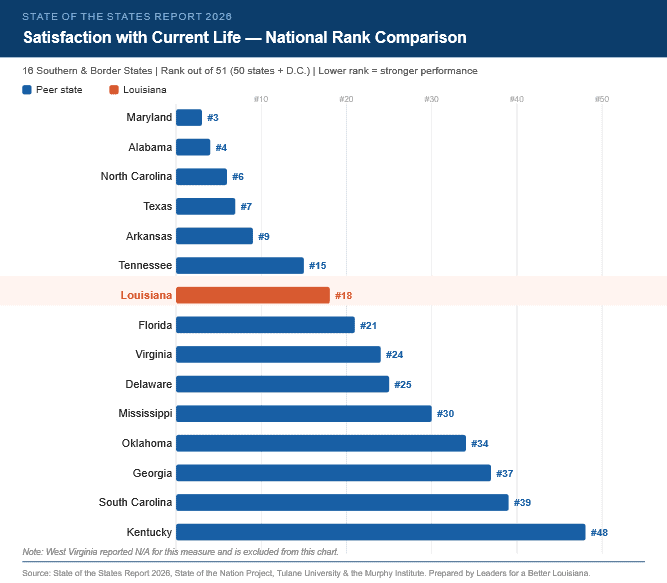
3. Life Satisfaction: Louisiana Ranks 18th
Among the measures where data are available for Louisiana, satisfaction with current life ranks 18th nationally, and came in 7th among the Southern states as shown on the chart. While the trend has been worsening – consistent with a national decline in self-reported happiness – Louisiana’s ranking has held relatively stable compared to peer states. The report uses modeled estimates for this measure given Louisiana’s limited sample sizes in the underlying General Social Survey data. It must be the food.
4. Volunteerism: Rising Faster Than the Nation, Despite Low Ranking
Louisiana ranks 44th on volunteerism, with 23.5 percent of residents volunteering through an organization in the past year. The notable finding here is the direction: Louisiana’s volunteerism trend has been improving more than the national trend, and the state has gained two or more rank positions over time. The report categorizes Louisiana’s comparison to the U.S. as positive.
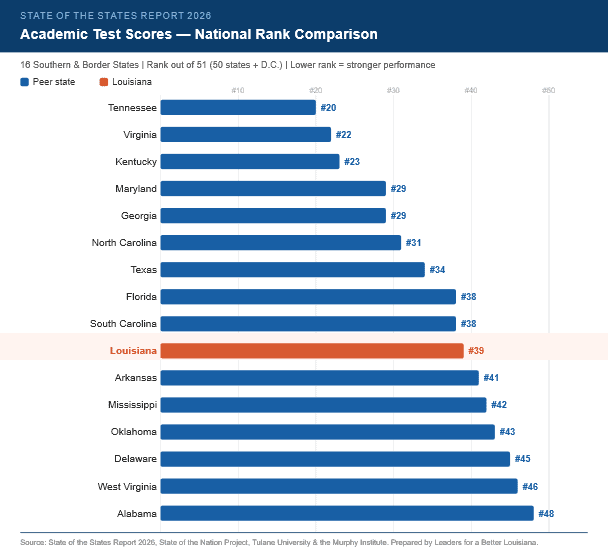
5. Education: Low But Trending Up
In this 2024 data, Louisiana ranks 39th on academic test scores (average eighth-grade scores across math, reading, and science on the National Assessment of Educational Progress). The state came in 8th among the Southern States, as shown in this chart to the right. The state’s trend in math and reading is one of the few genuine bright spots in the report – improving faster than the national average in both subjects. As more recent headlines have attested, this trend of education gains has continued after the data used in this report.
WHERE LOUISIANA FACES PERSISTENT CHALLENGES
6. Poverty and Its Connections: Louisiana Ranks 50th
Louisiana ranks 50th on the Supplemental Poverty Measure – a comprehensive calculation that accounts for government transfers, taxes, and necessary out-of-pocket expenses – with 18.7 percent of residents living in poverty as of 2023. Louisiana’s poverty trend has been worsening while the national rate has stabilized, and the state has declined in ranking over time. The poverty finding is not isolated. The report’s data show that Louisiana also ranks 50th on child mortality, 50th on single-parent households (40.7 percent of children), 50th on low birthweight births (11.2 percent), and 50th on life expectancy. These outcomes are deeply interconnected: poverty is a recognized driver of low birthweight, single-parent household instability, child mortality risk, and shorter life spans. Taken together, they represent a compounding burden on Louisiana’s children and families that no single policy can address in isolation.
7. Education To Workforce Pipeline: Ranked Last or Near-Last Across Measures
While improving faster in reading and math than the national averages, the deeper education concern from the report is the talent pipeline beyond the classroom. Louisiana ranks 48th on average years of educational attainment (14.4 years for adults ages 25–64). The state ranks last (51st) on the percentage of young adults ages 16–24 who are either employed or in school, and is worsening relative to the national trend. Louisiana ranks 51st – last in the nation – on both the employment-to-population ratio and the labor force participation rate among prime-age adults (ages 25–54). The employment-to-population ratio stands at 75.3 percent for prime-age workers, compared to a stronger national figure. Hourly earnings growth is also ranked last, with real wages declining 0.01 percent in 2024. Long-term unemployment ranks 47th. While both the employment ratio and participation rate are improving in trend terms, they are doing so at a pace that has not moved Louisiana out of the bottom position.
8. Economy: GDP Improving but Losing Ground Relative to Peers
Louisiana’s real gross domestic product ranks 26th nationally and the trend is improving. However, the report categorizes Louisiana’s comparison to the U.S. as negative – meaning that while the state’s economy is growing, it is doing so more slowly than the national average and has declined in relative ranking over time. Productivity ranks 48th. Together, these figures describe a state economy that is gaining in absolute terms but slipping in competitive position relative to other states.
9. Physical Health: Life Expectancy Ranked 46th, Trend Positive
Louisiana ranks 46th on life expectancy, with a trend that is improving – and improving faster than the national trend, earning a positive comparison rating from the report. Louisiana has gained two or more rank positions over time. The report’s authors note that life expectancy is shaped by a wide range of upstream factors measured elsewhere in the report, including low birthweight, poverty, social isolation, and violence – all areas where Louisiana ranks in the bottom tier. The gap to the national average remains substantial.
10. Social Capital and Trust: Isolated Rankings Signal Fragile Civic Health
Louisiana ranks 47th on social isolation – the percentage of adults who report not getting the social and emotional support they need. Trust in the federal government ranks 28th and is worsening relative to the national trend. Trust in science ranks 48th, with the state’s trend classified as unclear due to limited data points. Louisiana has no comparable data available for trust in other people. These indicators collectively point to a civic environment where residents report weak social support networks and declining institutional confidence – conditions the research literature links to worse outcomes in health, civic participation, and economic mobility.
CONCLUSION
While discouraging, this report does give citizens an honest, apples-to-apples look at where our state stood in 2023-2024. Some of the trends are genuinely encouraging: our murder rate is falling, test score gains in math and reading are outpacing the nation, and our volunteerism is rising.
But the structural challenges for Louisiana are concerning, and require more focused action by state and local leaders. A state that ranks last in workforce participation and near-last in poverty, life expectancy, and youth disconnection cannot grow its way out of those problems without targeted policy action. Taken together the data in this report present a charge to Louisiana’s leaders to develop real plans to improve these outcomes on behalf of citizens.
The authors summarized their findings with five conclusions in their executive summary, including three that are important to restate here:
- Geography matters — but it’s not destiny.
- No state is improving on an alarming number of measures.
- A stronger economy does not seem to improve personal well-being — but it may build social trust.
As for Better Louisiana’s take, we believe this method of non-partisan data tracking of state performance should continue to be gathered and analyzed more frequently, and if possible gathered in a common way down to the parish level. The brutal honesty of data may drive greater accountability toward more urgent action.
And as we have seen with our recent gains in education, when we focus on priorities and develop meaningful policy responses, we can see tangible and positive results.