
A report released last week showed Louisiana public school students have led the nation in reading improvement since 2022, and ranked second for growth in math. The study from researchers at Harvard, Stanford, and Dartmouth provides further validation that recent policy changes in Louisiana are having a positive impact.
The Education Report Card was established in 2022 to measure the progress of education improvement across the nation in the aftermath of the COVID pandemic. It is unique in that it uses methodologies that allow researchers to look at test results in most states and place them on a scale that can show state-to-state comparisons.
Among its findings:
- Louisiana ranks first among states in reading growth and second among states in math growth between 2022-2024.
- Louisiana is the only state to surpass 2019 pre-pandemic performance levels in reading and one of only two do so in math.
- Louisiana is the only state to surpass pre-pandemic performance levels in both reading and math.
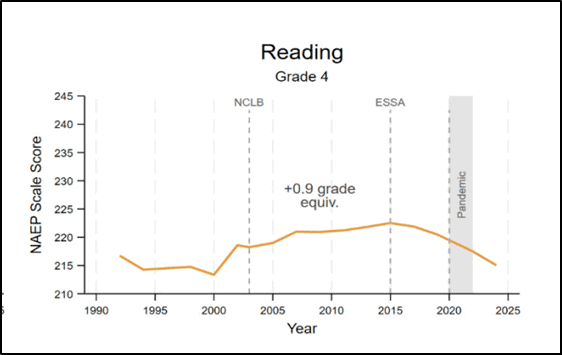
Overall, the report paints a grim picture of student learning trends across the country starting in about 2013. It says the United States, as a whole, entered a “learning recession” at that time as student progress, particularly in reading, stalled and achievement began to decline. In fact, it found that the average annual loss in student achievement just prior to the pandemic was just as large as the decline that occurred during the pandemic.
That is illustrated in the chart below, which looks at 4th Grade Reading, but the study found similar outcomes for Math.
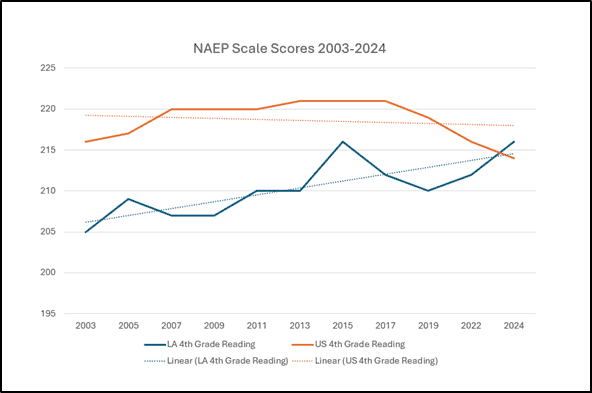
What is interesting to note is that in 4th Grade Reading performance, Louisiana followed only part of that trend. Scores in Louisiana dropped some after an unusual spike upward in 2015, but the trend line reflects an overall upward trajectory since 2003. So, what could be the reasons for that national decline and why was Louisiana able to buck that trend?
Researchers for the Education Report Card note that a couple of things happened around 2013. The federal government dismantled some of its accountability requirements around standardized testing and as a result many states relaxed their own standards in that area. The researchers also point to 2013 as the beginning of the rise in the use of social media.
Social media impacted the entire country so no state, including Louisiana, was immune from that. But in Louisiana, some other things were different. The state did not back off on accountability. While it has moved to reduce the time students spend taking the end-of-year LEAP assessment, it has also strengthened its accountability system, which continues to provide a strong incentive for local school districts to improve student performance.
The report also notes that all of the states that did show improvement in reading scores after the pandemic were ones that had begun to implement literacy reforms knows as the “science of reading.” Louisiana adopted it in 2020-2021. Basically the “science of reading” is a back-to-basics approach that emphasizes explicit instruction in phonics, phonemic awareness, vocabulary, and reading comprehension.
In Louisiana the reforms included revamping teacher preparation programs in reading, additional training for teachers in the early grades, and universal literacy screening for K-3 students. About that time the state also began to invest heavily in high-dosage tutoring in reading and math for students through the fifth grade. That included a concerted effort to identify struggling students early and provide meaningful academic interventions in a structured and targeted way.
All of these things appear to have paid off. It may require additional research to come to definitive conclusions on why Louisiana stands out so clearly from most other states. But taken together the implementation of these initiatives suggests the state is on the right path when it comes to foundational teaching and learning in the early grades and it should stay the course.
From Better Louisiana’s perspective, this latest study continues to validate what other data has shown – that Louisiana’s progress is real and it is commanding the attention of others around the country. It also strongly suggests that good policy does make a difference. Often policy changes are seen as something abstract that doesn’t necessarily yield real world outcomes.
But these results strongly suggest otherwise. We are still not where we want to be, but the fact that Louisiana’s improvement in student performance is now outpacing the nation shows real progress is achievable. But only when we make it a true priority.