
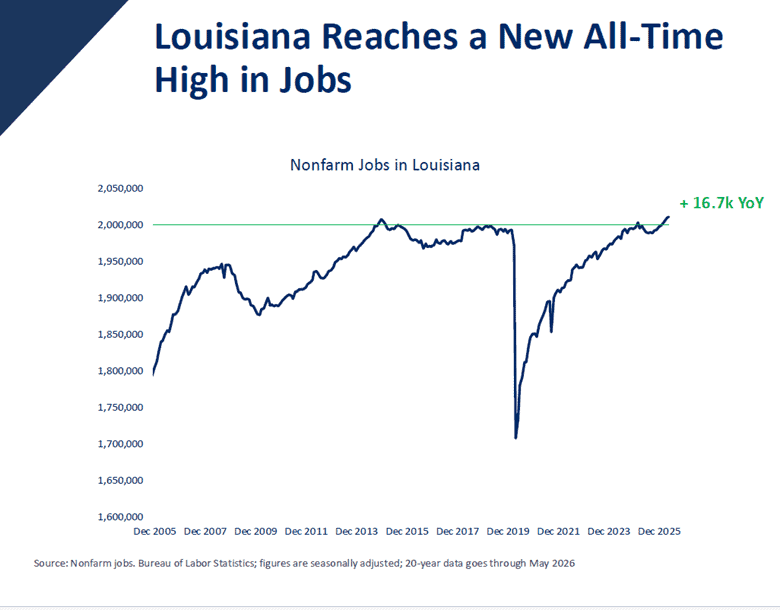
For decades Louisiana has watched its neighbors prosper with the weary patience of a diner whose food never arrives. Texas boomed. Florida swelled. Even Mississippi occasionally had something to celebrate. So the figures in our latest quarterly economic update may make unfamiliar reading. In May, the state’s payrolls crossed 2.01 million for the first time, a record, and have now sat above the 2 million mark for four consecutive months. You can flip through the full slides from the Q2 2026 Economic Update here
Nor is the milestone a statistical fluke. Louisiana added 16,700 jobs in the year to May, a growth rate of 0.8 percent that ranked fourth among the 16 states of the South. Only North Carolina, West Virginia and South Carolina did better, and the last of these only just: South Carolina’s margin was 0.847 percent to Louisiana’s 0.838, a gap of less than a hundredth of a percentage point. Output tells a similar story. Real gross domestic product grew by 2.7 percent over the year, again fourth in the region, comfortably ahead of the Southern average of 2.2 percent and level with the country as a whole.
The engine behind all this is easy to identify. Construction added 9,300 jobs over the year, more than any other sector, as a pipeline of industrial megaprojects moved from press conference to pouring concrete. In the northeast, Monroe grew faster than any metro area, at 1.3 percent, thanks to Meta’s now-$50 billion data center that is rising in Richland Parish. Lake Charles expanded by 1.2 percent on the back of liquefied natural gas terminals. And the Baton Rouge metro area added the most jobs outright, some 7,900, built upon the mettle of Hyundai Steel among others.
Policymakers can claim a share of the credit. In 2024 the state flattened its individual income tax to 3 percent, cut the corporate rate to 5.5 percent and abolished its franchise tax. The Tax Foundation, a think-tank, duly moved Louisiana up six places in its 2026 competitiveness index, to 31st nationally, the largest jump of any Southern state. Champagne should be kept on ice, however. Even after the climb, the state’s tax code ranks a middling 12th among its 16 regional peers. In the South, it seems everyone is reforming.
Beneath the cheerful headline numbers sit less flattering ones. The growth is narrow. Six of the state’s ten metro areas added jobs, which means four did not; Houma and Shreveport shrank fastest for the period. Eight of 14 industries expanded, led by construction, health care (4,000 jobs) and manufacturing (3,600), while arts and recreation, the federal government, and transport and warehousing all contracted. Unemployment, while low at 4.5 percent, remains slightly above the Southern average of 4.1 percent and among the four highest rates in the South.
The more worrying signal concerns what happens when the hard hats come off. Louisiana’s expansion rests on a concentrated pipeline of capital projects rather than on forming businesses. New business applications have risen by 48 percent since 2019, which sounds impressive until set against the neighbors: the pace ranks 15th of 16 Southern states. Construction jobs are, by their nature, temporary. If new firms do not form behind the megaprojects, the boom risks leaving little residue.
Households, meanwhile, face a distinctly Louisianan tax that no legislature has repealed: the weather. Carrying the burden of past and future storms, the average homeowners insurance premium runs to $5,986 a year, roughly 2.4 times the national average of $2,543 and the second-highest burden in the South. A friendlier tax code is cold comfort when the insurance bill devours the savings.
One statistic requires careful handling. Weekly unemployment claims fell by about 32 percent over the year, to roughly 9,400. Some of that reflects a genuinely tighter labor market. Some of it may also reflect Act 412, a law passed in 2024 that cut the maximum duration of benefits from 26 weeks to 12. Fewer claims are not always fewer hardships.
We think it’s best to see the Q2 report’s moment as an assignment rather than a victory lap, and urge policymakers to continue to address workforce shortages and encourage growth beyond the construction sites. Louisiana has momentum now. Whether we have built a sturdy economy will become clear when the cranes move on.