
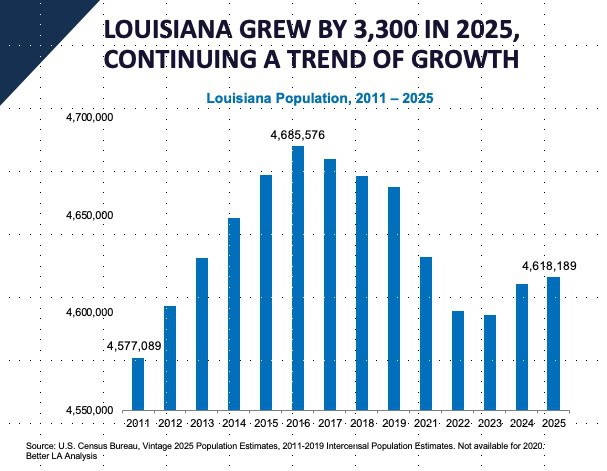
For six years the story of Louisiana’s population was a story of departures. From 2017 through 2023 the state shrank annually, a slow bleed of residents to faster-growing neighbors. So the finding at the center of our new population and migration report counts as news: in 2024 the state grew again, adding 16,100 residents, its first increase since 2017, and in 2025 it grew again by 3,300.
You might be tempted to picture newcomers streaming across the state line. But Louisiana’s turnaround owed less to arrivals than to a collapse in departures. From the most recently available data on migration patterns (2024), domestic out-migration – people leaving Louisiana – fell to 84,194, its lowest since 2010 and roughly 17,000 below the previous year. Domestic in-migration rose too, but only modestly. Set against 96,254 total arrivals through domestic and international in-migration, that equates to a net in-migration of 12,060, the first positive figure since 2016.
A state need not necessarily become a bigger attractor: To stop shrinking, it also can give its residents fewer reasons to pack.
Where they come from, and where they go
The report also maps the currents, drawn from 2023 flows, the latest available and a year behind the 2024 totals. The pattern is familiar. Texas remained the great rival, drawing a net of roughly 7,000 residents away, the state’s largest single loss. The pull west is structural, or maybe gravitational, and one good year does not reverse it.
More novel is the flow the other way. Louisiana posted minor net gains from three high-cost states, led by California, New Jersey, and New York. The numbers are small, but the direction is notable: when residents of the country’s most expensive states start to find Louisiana the better bargain, affordability becomes an asset to market.
Equally fascinating is that international arrivals have nearly doubled since 2017, steadily growing to more than 24,000, and now supply roughly a quarter of all of Louisiana’s in-migration. Although this is with the caveat that this pattern was prior to the federal government’s substantial changes to border immigration policy under the second Trump presidency.
One swallow, and the question of summer
The temptation is to declare a corner turned. The data counsel patience. This is blip of small growth after six of decline. We know that the mechanism behind it, falling departures, is the more fragile of the two levers. Out-migration can fall because opportunity improved, or merely because fewer residents could move that year; only sustained gains distinguish the two. Domestic in-migration, the sturdier signal of a state people actively choose, remains weak.
The population numbers suggest that we may have stopped losing, which is not the same as winning. The former can be achieved by inertia; the latter requires affirmative reasons to come and to stay. Our recent second quarter economic update showed Louisiana’s record employment, and improving tax code, could supply part of the case.
More can still happen to drive net migration, such as:
- Adopt a domestic migration strategy. The state and its metro regions might need to create a multi-pronged, multi-agency effort to sustain positive net domestic migration for five straight years, so a single good year becomes a trend rather than an anomaly.
- Convert retention into recruitment. The state has started investing in “talent marketing” for each of the last two years. This can help present the state’s affordability to high-cost states, where Louisiana already posted some gains.
- Build policy and messaging around young families, the group that drove the inflow. Prioritize the factors parents weigh most: school quality, affordability, childcare access, and public safety.
- Defend the affordability advantage. The state’s high homeowners and auto insurance premiums undercut the cost-of-living edge that draws migrants in the first place. Further pushing to lower these protects the state’s chief selling point.
- Diagnose the mid-career leak. Residents aged 35 to 44 were the largest group to leave. The state should learn why it loses people in their peak earning and family-forming years, and target its efforts there.
The 16,000 who tipped the ledger in 2024 have made their choice. The task for its leaders is to ensure next year’s families make the same one. Momentum, once lost, is expensive to rebuild. The state has been handed a little. What it does with it is the question that counts.
Sources: U.S. Census Bureau, Vintage 2025 Population Estimates, 2011-2019 Intercensal Population Estimates; also American Community Survey 1-Year Estimates; Lightcast Q3 2026 data, reflecting the 2023 state-to-state migration year. ACS 1-year estimates were not released for 2020; that year’s population figures are omitted and its migration figures interpolated.