
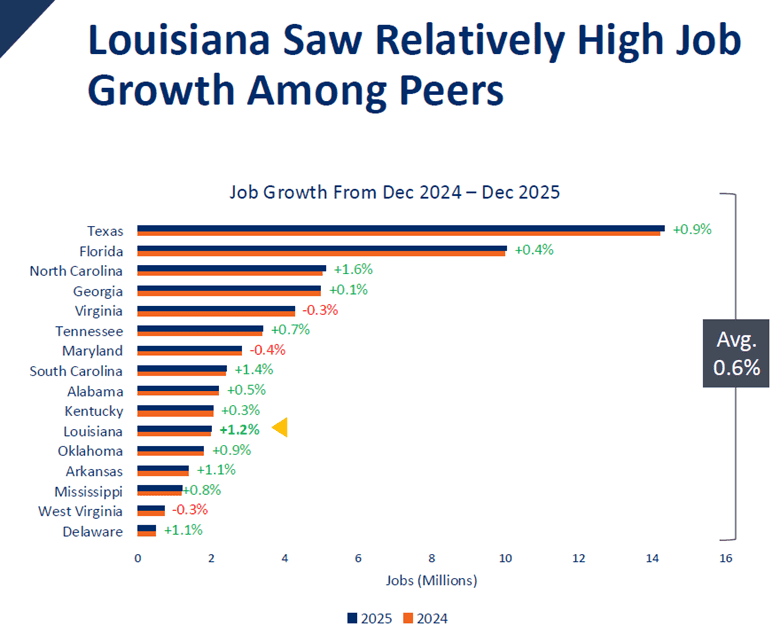
Better Louisiana’s First Quarter 2026 Economic Update highlights encouraging trends across the state’s economy and communities. See Report Here. Louisiana added almost 23,000 jobs in 2025, ranking third in the South for job growth and keeping employment above 2 million for a record eight consecutive months. Job increases stretched across every major region, with Slidell, Baton Rouge, Lake Charles, and Monroe leading the way.
The report also shows signs of progress in the workforce, affordability, and safety. Unemployment ended the year at 4.2 percent, below both pre-pandemic and year earlier levels, and unemployment claims dropped 41 percent from early 2025. In large part, this seems to be driven by the broad-based expansion across major sectors that’s underway. The report shows that ten out of fourteen major industries added jobs, led by health care (over 10,000), professional services, and construction.
In another surprise to us in the data, Louisiana ranked second in the South for domestic in-migration, adding 72,028 new residents in 2024 (the most recently available data). While we’ve seen mixed trends in population performance statewide over the last decade, it’s positive to see relatively strong in-migration from other states. We think that one reason for this is that housing affordability remains an advantage, with median homes about 16 percent more affordable than the national average.
Another exceptionally positive surprise was in a key public safety indicator making gains, with homicide rates falling nearly 60 percent between 2021 and 2025. That accounted for the third largest drop among benchmarked states. Unfortunately there was a lot of room for improvement, but it’s a positive sign of progress for an issue that was a defining topic in many local and statewide elections during that period.
Infrastructure spending continues to strengthen the foundation for long-term growth. Louisiana now ranks in the top half of Southern states for highway maintenance spending growth after a decade of consistent increases.
We were also pleased to include a national index measuring every state’s manufacturing workforce pipeline that ranks Louisiana ninth nationally, outperforming much larger industrial states. This one indicator alone could be a solid argument for future manufacturing investment into Louisiana.
By sustaining investments in workforce development, infrastructure, and affordability, we hope that Louisiana can turn this recent progress into long-term prosperity for every community.