
Louisiana has spent years competing for major industrial investments. Now, we’re beginning to see the results. Big time.
Twelve major industrial and technology projects announced in the last year or so represent approximately $282 billion in investment and could create 7,550 permanent jobs. But building them will require a lot of people—and finding enough workers may be one of our biggest challenges.
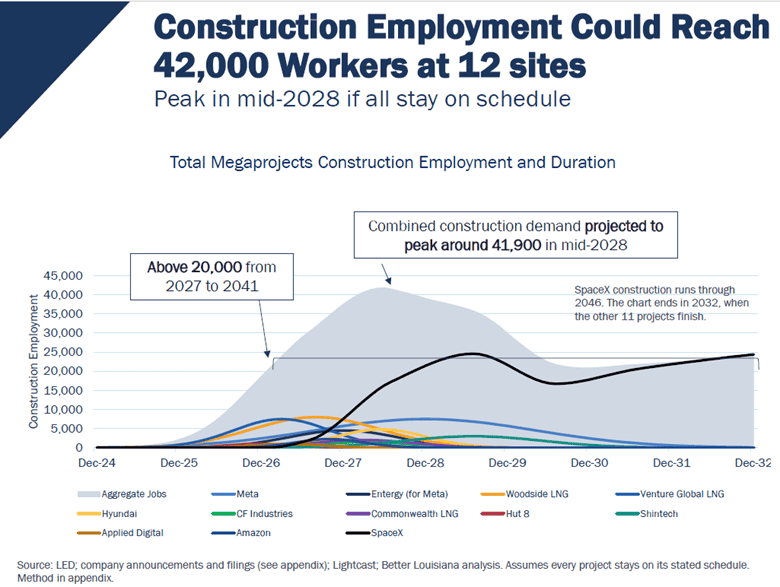
A new Better Louisiana report puts all of that into perspective. It estimates that at their peak these projects alone could require nearly 42,000 construction workers by mid-2028, about half of the state’s current industrial construction workforce.
The pressure will be especially intense in Lafayette, Lake Charles and Monroe. Those three regions account for 81% of projected peak demand but have only 17% of the state’s existing industrial construction workers. Even if every local worker were available, the regions would still be nearly 19,000 workers short. Baton Rouge has by far the state’s largest industrial construction workforce. But how many will stay given the extraordinary demand in other regions?
And it’s not just about numbers, it’s also about skills. Data centers need HVAC workers, while LNG facilities rely heavily on pipefitters. Just about everyone needs electricians. The good news is that Louisiana has done a lot recently to ramp up training, but significant gaps remain in several highly-skilled, high-demand occupations.
As it turns out, this is not just a short-term phenomenon. While the peak demands will come in the next year or so, our analysis suggests that over the next decade or more these projects alone will continue to employ more than 20,000 industrial construction workers – nearly a quarter of our current construction workforce. And that doesn’t count any other major projects that signs suggest might still be in our future.
Yes, the opportunity before us is enormous. But in this case, attracting these big investments is only half the job. Louisiana must also expand its workforce and prepare communities to meet the coming demand. Stronger partnerships among employers, educators, and training providers will be essential if we want our people—and our state—to reap the substantial potential from this historic wave of investment.