
Key Points
- The Minimum Foundation Program (MFP) is the mechanism Louisiana uses to fund PreK-12 public education. Lawmakers have created a task force to undertake the most comprehensive review of the MFP in more than 30 years, driven by a desire to provide a permanent and predictable pay raise for teachers and school support staff.
- Prior to the first meeting of the task force the Governor and Legislature approved an unprecedented $168 million cut to the MFP, using those savings to fund a temporary teacher pay stipend while they seek a permanent source of funding for pay raises.
- Because the MFP is a complex formula that is generally poorly understood, Better Louisiana has developed this simplified explanation of how that important funding formula actually works.
What You Need to Know
- The constitution requires that each year the Board of Elementary and Secondary Education (BESE) develop a formula (the MFP) to distribute state funding to local school districts.
- Under the constitution, the Legislature cannot make any changes to the MFP. Lawmakers can approve it, reject it, or choose not to act on it at all.
- If they reject it or don’t act on it, the version of the formula legislators last approved remains in place.
- The last time lawmakers approved the MFP was in 2022, which means that formula design and level of funding remains the version that is currently in place.
What Is the MFP?
- The MFP is the funding formula Louisiana uses to determine the minimum state and local funding required for public education, and the mechanism it uses to distribute state aid to local school systems.
- Its purpose is to determine the cost of a “minimum foundation program of education” in all public schools.
- While the constitution doesn’t define what a “minimum foundation program of education” is, the MFP resolution presented to lawmakers each year describes it as the “minimum cost of education based on the education needs of each student.”
- That resolution also requires that at least 70% of state and local education funds are spent “in the areas of instruction and school administration at the school building level.”
- Lastly, the constitution says the MFP must “equitably allocate the funds” to school systems across the state.
Student and District Equity Provisions
The MFP operates as a student-based, weighted funding formula, which is the most common type of funding mechanism in the country. It starts with an annual base per pupil amount which for the last seven years has remained at $4,015 per student. Basically, that is the amount the formula uses as a starting point to pay for each student in public schools.
But it also recognizes that some students require more resources to educate than others, so it provides additional weights for those students across various categories. That means districts receive a percentage of money on top of the base amount for each of these students:
- Students with disabilities: 150% above the baseline
- Gifted and talented: 60% above the baseline
- Economically disadvantaged and English language learners: 22% above the baseline
- Career & Technical Education students: 6% above the baseline per course taken.
In addition, there is a sliding scale calculated for smaller school districts with 7,500 or fewer students which allows them to receive up to 20% more of the base. This is intended to offset their higher fixed costs per pupil because they lack the economies of scale of larger districts.
The formula also measures each district’s ability to generate local revenue and adjusts the state’s share accordingly. For instance, districts in urban or industrialized areas typically have higher sales and property tax bases enabling them to generate more revenues at a reasonable rate of taxation.
Many rural districts with few retail outlets and lower property values lack the capacity to raise needed revenues without prohibitively high tax rates, so they also receive additional state funding. These equity provisions are seen nationally as important elements of a school financing formula. Research generally finds that well-designed weighted and equalized funding systems improve educational opportunity and, in many cases, student outcomes.
Four Levels
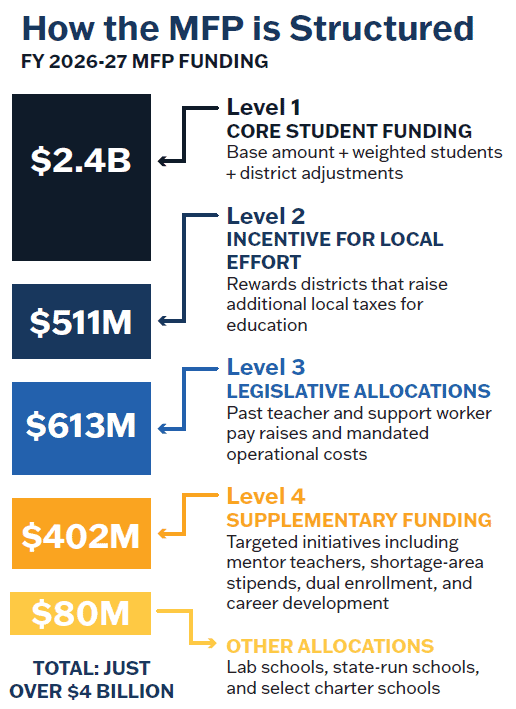
Over time, the MFP has been divided into four levels:
- Level 1: Core Student Costs and Equitable Distribution. This is the largest funding component of the MFP, representing about 60% of total allocations. It includes the total base per pupil amount based on annual enrollment ($4,015), plus the added weights for certain students, and the additions based on the district’s capacity to generate tax revenues and size of the school district. The law, on average, calls for the state to fund 65% of the total Level 1 cost of education. Local districts are expected to fund the other 35%. However, these percentages only reflect a statewide average. The real percentage of state and local contributions vary by district because of the equity adjustments for less-wealthy districts. Because of that, some districts receive more than 65% from the state and contribute less than 35% and vice versa. (Total: Approximately $2.4 billion)
- Level 2: Incentive for Local Effort. The state, through the formula, also incentivizes districts to contribute more funding to education than the targeted 35% local share. This is based on districts that successfully raise more local sales or property taxes to support public education. Those that do, mostly larger districts and those with more taxing capacity, are rewarded with extra money. (Total: Approximately $511 million)
- Level 3: Legislative Allocation: These are dollars added to the MFP mostly to cover the cost of past legislatively approved teacher and support worker pay raises and some mandated operational costs. (Total: Approximately $613 million)
- Level 4: Supplementary Funding. These are largely targeted allocations to meet needs in high priority areas. This includes programs for career development, mentor teachers, stipends for teachers working in high shortage areas, and supplemental courses like dual enrollment and apprenticeships. (Total: Approximately $402 million)
Unlike Levels 1 and 2, which are both adjusted through the MFP’s wealth-equalization process, Levels 3 and 4 are distributed based on the purposes specified in the MFP resolution, not on a district’s local tax capacity. In addition, outside these levels approximately $80 million is set aside for lab schools (operated by universities), state-run schools (such as the Louisiana School for Math, Science, and the Arts), and some charter schools. Together it all totals just over $4 billion dollars for the 2026-2027 fiscal year.
And that in a nutshell is the MFP.
Observations
Thirty years is a long time since the state’s last comprehensive review of the MFP and it is likely that improvements can be made. For instance, some have argued that its assumptions about the cost of educating students are outdated, it is too complicated, it does not deliver all funding on an equitable basis, and it should be updated to include performance incentives to reward key outcomes.
The review is also coming at a time when student enrollments are declining statewide. Because much of the formula is student-based, that results in an overall reduction in state funding. Even though that also means there are fewer students to educate, districts argue the reductions hurt their bottom line because they have no control over many fixed costs.
On the flip side, current circumstances might encourage districts to think more about administrative consolidations to cut costs, or prompt lawmakers to consider ways to support local districts that make the difficult decision to close schools when fewer classrooms are needed. Issues like these should also be a part of the discussions surrounding the future of school financing in Louisiana.
Conclusion
As lawmakers begin a review of the MFP to see if it can be restructured to support a permanent pay raise for teachers, we should note that the current formula includes several features that national best practices and research-based evidence suggest are key to a strong school financing mechanism:
- It is based on student enrollment.
- It recognizes that the cost of providing an education can vary greatly based on students’ individual needs.
- And it allocates state funding to address the challenges of school districts that have a limited tax base and smaller numbers of students, important considerations for many rural school systems.
Key components such as these might be adjusted in the future, but they should not be discarded.
Finally, in considering a new formula for state aid to public education, policy makers should take care to preserve elements that are critical to improving student outcomes. And they should be guided by the pillars of adequacy, fairness, and equitable distribution that experts say an effective, modern funding formula should possess.